Jaybird SB2 Sportsband Bluetooth stereo Headphones


The Jaybird SB2 Sportsband headphones come in a range of funky colors and they are Bluetooth A2DP compatible.
 Jaybird SB2 Headphone is compatible with apt-X Bluetooth Audio Codec which is included in Apple’s Mac Mini. The headset works like charm with any Bluetooth A2DP audio device or devices having 3.5 mm Audio Jack via uSport Universal Bluetooth Adapter. Also if you want the headset to provide great quality audio experience with your iPhone, you need to shed an additional $50 for iSport adaptor.


Category: 0 comments

FIFA World Cup 2010 commemorative flash drives

Amkette, the maker of digital storage and lifestyle peripherals, has introduced a special offer for soccer lovers, Amkette World Cup Series Flash Drives.  

The 4GB World Cup commemorative flash drives are suited up and ready to play, in the team jersey of three of the top soccer teams this year, Red for Spain, Yellow for Brazil and White for England are ready to score on your USB port. The jersey also has a lanyard for easy attachment with cell phones and keyrings. 

The USB flash drives have been designed in the shape of a jersey. The World Cup jersey shaped USB Drive comes with 4GB storage capacity. It features USB 2.0 connection, works like other USB drives which requires no driver, allows plug and play function to work on various Os including Windows 7, Vista, XP, 2000 and Mac OS.
Category: 0 comments

Quantum Teleportation

 Teleportation is the name given by science fiction writers to the feat of making an object or person disintegrate in one place while a perfect replica appears somewhere else. How this is accomplished is usually not explained in detail, but the general idea seems to be that the original object is scanned in such a way as to extract all the information from it, then this information is transmitted to the receiving location and used to construct the replica, not necessarily from the actual material of the original, but perhaps from atoms of the same kinds, arranged in exactly the same pattern as the original. A teleportation machine would be like a fax machine, except that it would work on 3-dimensional objects as well as documents, it would produce an exact copy rather than an approximate facsimile, and it would destroy the original in the process of scanning it. A few science fiction writers consider teleporters that preserve the original, and the plot gets complicated when the original and teleported versions of the same person meet; but the more common kind of teleporter destroys the original, functioning as a super transportation device, not as a perfect replicator of souls and bodies. 

In 1993 an international group of six scientists, including IBM Fellow Charles H. Bennett, confirmed the intuitions of the majority of science fiction writers by showing that perfect teleportation is indeed possible in principle, but only if the original is destroyed. In subsequent years, other scientists have demonstrated teleportation experimentally in a variety of systems, including single photons, coherent light fields, nuclear spins, and trapped ions.  Teleportation promises to be quite useful as an information processing primitive, facilitating long range quantum communication (perhaps unltimately leading to a "quantum internet"), and making it much easier to build a working quantum computer.   But science fiction fans will be disappointed to learn that no one expects to be able to teleport people or other macroscopic objects in the foreseeable future, for a variety of engineering reasons, even though it would not violate any fundamental law to do so. 
In the past, the idea of teleportation was not taken very seriously by scientists, because it was thought to violate the uncertainty principle of quantum mechanics, which forbids any measuring or scanning process from extracting all the information in an atom or other object. According to the uncertainty principle, the more accurately an object is scanned, the more it is disturbed by the scanning process, until one reaches a point where the object's original state has been completely disrupted, still without having extracted enough information to make a perfect replica. This sounds like a solid argument against teleportation: if one cannot extract enough information from an object to make a perfect copy, it would seem that a perfect copy cannot be made. But the six scientists found a way to make an end run around this logic, using a celebrated and paradoxical feature of quantum mechanics known as the Einstein-Podolsky-Rosen effect. In brief, they found a way to scan out part of the information from an object A, which one wishes to teleport, while causing the remaining, unscanned, part of the information to pass, via the Einstein- Podolsky-Rosen effect, into another object C which has never been contact with A. Later, by applying to C a treatment depending on the scanned-out information, it is possible to maneuver C into exactly the same state as A was in before it was scanned. A itself is no longer in that state, having been thoroughly disrupted by the scanning, so what has been achieved is teleportation, not replication. 

As the figure above suggests, the unscanned part of the information is conveyed from A to C by an intermediary object B, which interacts first with C and then with A. What? Can it really be correct to say "first with C and then with A"? Surely, in order to convey something from A to C, the delivery vehicle must visit A before C, not the other way around. But there is a subtle, unscannable kind of information that, unlike any material cargo, and even unlike ordinary information, can indeed be delivered in such a backward fashion. This subtle kind of information, also called "Einstein-Podolsky-Rosen (EPR) correlation" or "entanglement", has been at least partly understood since the 1930s when it was discussed in a famous paper by Albert Einstein, Boris Podolsky, and Nathan Rosen. In the 1960s John Bell showed that a pair of entangled particles, which were once in contact but later move too far apart to interact directly, can exhibit individually random behavior that is too strongly correlated to be explained by classical statistics. Experiments on photons and other particles have repeatedly confirmed these correlations, thereby providing strong evidence for the validity of quantum mechanics, which neatly explains them. Another well-known fact about EPR correlations is that they cannot by themselves deliver a meaningful and controllable message. It was thought that their only usefulness was in proving the validity of quantum mechanics. But now it is known that, through the phenomenon of quantum teleportation, they can deliver exactly that part of the information in an object which is too delicate to be scanned out and delivered by conventional methods.

Category: 0 comments

World's most Powerful microscope : TITAN 80-300 Cubed

This powerful microscope named Titan 80-300 Cubed was installed at the University early in the summer, and since then it has been put through its paces to achieve unprecedented resolution. This microscope is so powerful that it can easily identify atoms, measure their chemical state and even probe the electrons that bind them together.
 
This microscope can be used to produce more efficient lighting and better solar cells, to study proteins and drug-delivery materials to target cancers. It will assess atmospheric particulates, and help create lighter and stronger automotive materials, more effective cosmetics, and higher density memory storage for faster electronic and telecommunication devices.
Canadian center for Electron Microscopy has developed a new powerful microscope that is world's most powerful microscope till date. According to Gianluigi Botton, Director of Canadian center for Electron Microscopy, says that the power of this microscope can be thought as equivalent to "taking Hubble Telescope and aiming it at atomic level".
 
Titan's ability can probe structure of solid materials to the atomic level and this will have an amazing impact on development and commercialization of new technologies from biomedical devices to water quality monitoring and improved energy storage systems.

This microscope has been build in Netherlands by FEI Company with a cost of about $15 million. This microscope can help to examine everyday products with its Nano details that can improve the efficiency of these products.
 
 
Category: 0 comments

Thinnest Cellphone on the Planet : iPhone 4


Iphone 4G will be Released likely around June or July of 2010. 

Lots of speculation is going around on the new iPhone 4g... in HD!!  Official features will be revealed at the WWDC conference this June.
Verizon Wireless is currently testing a CDMA version of the iPhone 4G and Verizon confirms they are making network changes to bring the iphone to their network. The new iPhone 4g is going to be loaded with awesome new features like video chat, multi-tasking and extreme downloading

iPhone 4G features Retina Display. It is a new display technology that packs in 326 pixels per inch. The new iPhone’s display will be the same 3.5-inch size of the current iPhone 3GS but it will have a resolution of 940 x 640 pixels and an 800:1 contrast ratio and the same IPS technology used in the iPad’s display.
Category: 0 comments

5 Latest Gadgets this 2010

1. XBOX : Project NATAL

Project Natal, a revolutionary new way to play: no controller required.  See a ball? Kick it, hit it, trap it or catch it.  If you know how to move your hands, shake your hips or speak you and your friends can jump into the fun -- the only experience needed is life experience  

"This is a pivotal moment that will carry with it a wave of change, the ripples of which will reach far beyond video games" STEVEN SPIELBERG

"For us, this E3 is about breaking down barriers – between generations, between games and entertainment, and most importantly, between dreamers and the future – in a way only Xbox 360 can." DON MATTRICK

2. Ford's MyKEY: ALLOWS FLEET OWNERS TO  CONTROL 
                               SPEED AND RADIO VOLUME FOR SAFETY

 Ford Motor Company is introducing an innovative new technology called MyKey that will help fleet owners encourage safer driving behavior by their vehicle operators. 

The feature, which will debut on several popular Ford fleet vehicles in mid-2009 at no additional cost, allows fleet customers to limit top speed and radio volume, set speed warnings, encourage safety belt usage, and assure important safety systems remain engaged to help protect drivers and vehicle inventories.
“MyKey gives fleet owners peace of mind by providing a simple, affordable way to help reinforce safe driving policies and manage at-risk drivers,” said Gerry Koss, Ford’s fleet marketing manager. “For fleet owners, safe driving behavior by vehicle operators is a bottom-line issue.” 

According to the National Highway Transportation Safety Administration (NHTSA), the average motor vehicle crash can cost an employer $16,500, while an on-the-job crash that results in injury can cost employers an average of $74,000. Motor vehicle accidents that result in the death of an employee or third party are even more costly. Traffic accidents are a leading cause of death for people who operate motor vehicles as part of their job. 

Ford’s MyKey can help fleet owners better mitigate one of the most prevalent factors contributing to traffic crashes – excessive speed. NHTSA data shows that speeding is a contributing factor in 30 percent of all fatal crashes. 

United States Infrastructure Company (USIC), a Carmel, Ind.-based utility services business that operates a fleet of 3,500 vehicles nationwide, could benefit from using MyKey, said Phil Samuelson, USIC purchasing and asset manager. The company uses many Ford trucks and SUVs, and its drivers put an average of 24,000 miles on each vehicle every year.

“Operating a fleet equipped with MyKey technology could be great for our business and our drivers,” Samuelson said. “By encouraging safety belt use and limiting the top speed and audio volume on our vehicles, we’d be better able to protect our employees and our fleet investment while potentially saving fuel, too.”
For MyKey, Ford improved an existing, proven technology – the SecuriLock™ passive anti-theft system – with software upgrades to develop a new unique feature for customers, said Jim Buczkowski, director, Electrical and Electronic Systems Engineering – the same team that developed SYNC in partnership with Microsoft. 

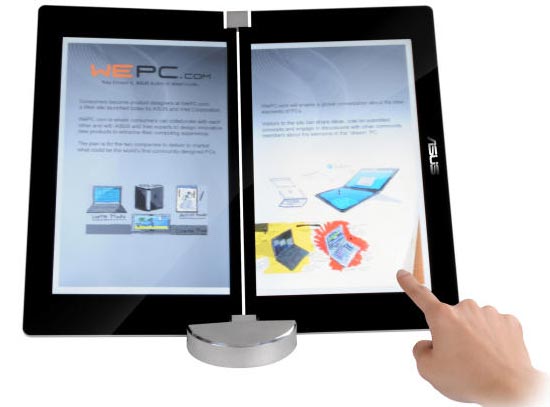
3. Dual Touchscreen Laptop
It may be snoozin' time on the East Coast of America, but things are already getting heated in Hannover. Live from the CeBIT floor, we present to you ASUS Dual Panel touchscreen PC. The show models were still very much conceptual, with the hinges showing signs of imperfections and the interface not quite ready to be touched by onlookers. We did spot that the units on hand were humming along on Windows 7, though. The on-screen keyboard looked great from where we stood, but it's tough to say how hard it would be to get used to banging out dissertations on a flat panel. At any rate, feel free to browse the gallery below -- and stick around, we'll be bringing you lots, lots more where this came from
4. HTC EVO 4G Phone


What is 4G?

The technical definition of 4G has many ins and outs but here’s what it means to the phone user: high speed internet access on the move with your mobile phone. The switch to 4G has already started and as mobile phone operators migrate from 3G to 4G mobile data bandwidth will increase to such an extent you’ll be able to download a full length DVD in a few seconds. The new fourth generation mobile phone networks will offer much higher capacity and faster speeds than the current 3G mobile phone network. Data bandwidth will be around ten times the speed of 3G. Higher access speeds will mean that a greater range of multimedia, cell phone games and other applications will available – for example, streaming HD television on your mobile handset will become a reality.

5. Hydrogen Rulz: Hydrogen Powered Cellphone
Fuel cell maker Angstrom Power and cell phone maker Motorola have teamed up to create a prototype mobile phone that runs on a hydrogen fuel cell. Hydrogen is produced--by cracking water molecules--with a desktop fueling station and then inserted into a metal hydride storage container on the phone, says Aron Levitz, manager of business development for Angstrom. When the hydrogen molecules pass through a membrane in the fuel cell, electrons are stripped away and get diverted to run the phone.
The two companies are trotting the phone to various trade shows. Start-up Angstrom has received investments from of Chrysalix Ventures.
Category: 0 comments

Water Wear for your iPad Tablet PC

 The Waterwear iPad case allows you to protect your iPad from moisture and it’s still operate the touchscreen through the transparent case. The case is also fitted with an adjustable neck strap allowing you to keep your iPad close and secure. The iPad being the newest obsession for many will need all of the random accessories that the rest of the Apple products have received.  Those of you that like to be around a whole lot of water might want to consider picking up this case.  It’ll make sure you have full use of your iPad, but it will also make sure that it stays completely dry. The case even has an incredibly attractive strap that can be used to make the iPad hang from your neck.  I’m sure you’ll pick up even potential partners if you hang this around your neck while you’re wearing a bathing suit at your local pool.  Of course should you want to make that particular fashion statement, you might have a little bit of a hard time getting one of these since it comes from a Japanese site.  If you’re feeling lucky though, it costs about $38.
Category: 0 comments
Related Posts with Thumbnails